My friend Bonnie‘s husband Ted is a bit of a wine guy. When not busy being a neurologist, he does podcasts and was a founding partner of a wine importing and distribution business. I love going over to their house for drinks because there is always good wine and even better, Ted likes to pull out new things for me to try. Like the bottle of Georgian wine he sent over for my birthday a few years ago. Continue reading
Category: wine
In which I begin to tackle French wine. And discover a lovely new local one.
The problem with people knowing I occasionally write about food and wine is that they think I know quite a bit on the subject. To be honest, I really only know about the food and wine I either like or have worked with. Which up until now, has not been French wine. If I’m going to be fully honest here, I am slightly intimidated by French wines – the appellations (a defined regional area), the Crus (still trying to grasp that one) the pronunciations (I butcher anything longer than a 2 cent word in my native tongue, my pronunciation of French is abysmal despite 3 years of French), the fact that French wines are among some of the most respected and most expensive wines in the world – I have at best, a rudimentary knowledge of French wines. I know just a little bit about Bourdeaux and Burgundies, that only French winemakers in a particular region produce true Champagne and that Cotes-du-Rhone and Chateneauf-du-Pape are regions for wine in France, but beyond that, I don’t know much about French wines. Continue reading
Wines I drank.
This weekend while picking up some shifts at l’etoile, I participated in some staff wine tasting. One of the things I enjoy about keeping a toe dipped in that world is staying up on current fine food & wine trends. It had been a while since I had rolled out my wine knowledge and I think I surprised some of my co-workers with how deftly I was able to describe the wines we were tasting. There was a French Sauvignon Blanc made in the New Zealand style – by far my preferred style of the variety, one I drink by the gallon during warm weather months. I call it the adult lemonade of summer. There was a Beaujolais that had a strong vegetable note – the first thing that sprung to mind when I tasted it was that I wanted a cheese plate to accompany it. Lastly was a Bordeaux, a Merlot/Cabernet Sauvignon blend, light on the palate with heavy tannins and fruity finish.
I always seem to surprise people with how much I know about wine. I don’t come across as someone who can navigate my way through a wine list. When “In the Kitchen” folded publication last year, it was suggested I continue to write about wine here and I meant to do that, but just haven’t. To be completely honest, I have long been on a quest to find the best wine for under $10 that I can. Because while I love wine and am not opposed to springing for a more expensive bottle now and again, I am inherently cheap. I can and will try that $3 bottle and unless it’s horribly undrinkable, I will drink it because dammit, I paid for that.
This of course led to another fantastic idea which is that I make a regular feature on here of wines I drink – good and bad, cheap and not so cheap. I have at least one friend who almost always takes a shot of the label I am serving her so that she remembers to grab it next time she’s looking for something good to drink. I’ve run into friends in the wine aisle of the grocery store who have asked me to please point out what it was they had last time they were at my house. I have had long talks with the owner of a local wine shop who agrees with me that you can find some very nice wines for not a lot of money. So, after promising last year to write more here about wine, I’m going to do so. Beginning now.
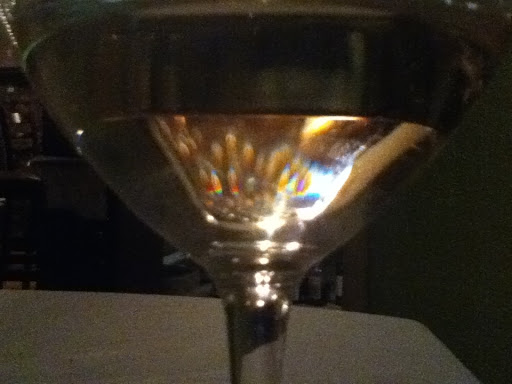
This was a glass of Trump Viognier I enjoyed after my Saturday evening shift. I noticed that at a certain angle, there was a rainbow in the glass. Which by no means is an apt description of the wine. Viognier is a grape that Virginia does well (so well it’s the official state grape), but I don’t think this is most stellar example of it. Trump’s Viognier is floral and slightly sweet, not as well balanced as other versions out there. I had been wanting to try some of the Trump wines just out of curiosity, but I can’t find anyone who wants to go to the winery with me. It seems no one I know wants to part with their money in order to give Donald Trump yet more money. At $19 a bottle, it’s not entirely out of the price range for what I would splurge on for a bottle of wine, but I didn’t find it splurge worthy.
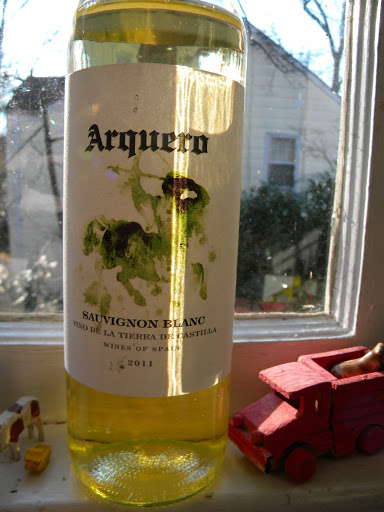
I’ve been on a bit of whites kick here lately. I think it’s part of my fondly moving time forward, like switching the Calendar to March when there are still 5 days of February left. I realize I did the same thing the end of winter last year as well. This is a Spanish Sauvignon Blanc made in the New Zealand style. I got this particular bottle at Whole Foods, but Reids carries it as well. I think it runs about $7.99/bottle. It’s the perfect combination of dry, citrusy crisp, fruity that I adore in New Zealand style Sav Blancs. And the price is right. Oh, and I can run to Reid’s to grab a bottle. What’s not to like about it?
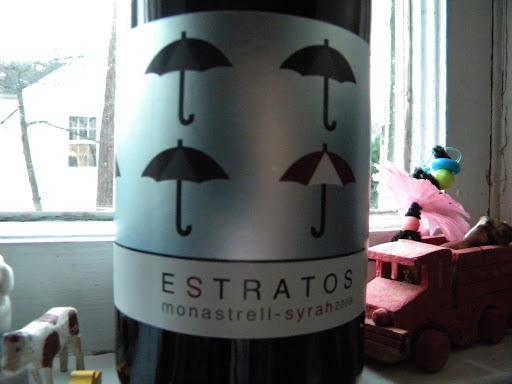
I’m not entirely drinking whites however. I find I like a glass of white and then switch it up to a red. I’ll admit I bought Estratos, a Spanish red because I thought it was a Syrah and it was in the cheap section at Whole Foods. I ran in there the other day for a few things (the essentials – milk, toilet paper & peanut butter, at least two of those being things that WholePaycheck has the best prices on) and grabbed a few bottles of wine while I was at it. I was sure I’d had it somewhere and liked it. Turns out, it’s not a syrah, it’s a blend, with 80% being Monastrell, a varietal from the Spanish Mediterranean coast. Monastrell is a varietal I wasn’t familiar with, which proceeded to send me on a mission to learn more about it in order to tell you about it. What I’ve learned? It’s a grape that is mostly blended. It’s described as ‘meaty’ and ‘herbal’, high in tannins as well as alcohol. With the case of this particular wine, I tasted the alcohol content, which is an indicator of a a poorly balanced wine. In fact, that was the overwhelming note of the wine – the alcohol. It had a slightly fruity finish, but the that first note held on for quite some time. I tried it with a few different foods and nothing seemed to temper it. I’ve read that this is a varietal that ages well – this particular bottle is a 2009 and while I could see where it could use a few more years to mellow, I’m not convinced this particular wine is worth giving up space in my ‘cellar’ to see if it goes age well. I’d rather move on.
I got my wine geek on.

This past weekend, Barboursville Winery held a vertical tasting – where one could taste different vintages of the same varietals. Among the offerings were Cabernet Sauvingnon Reserve, Cabernet Franc Reserve, Nebbiola Reserve and Octagon. Tasting this way, you can see the differences aging can play in a varietal, as well as weather.
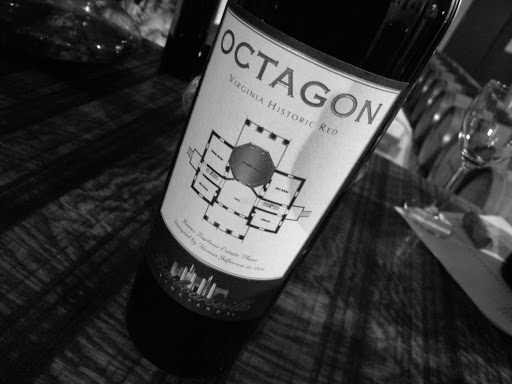
Octagon is a Bordeaux style blend known in this country as Meritage. These wines use the 5 standard Bordeaux grapes – Cabernet Sauvingnon, Cabernet Franc, Merlot, Petit Verdot and Malbec. There is a 6th Bordeaux grape, Carmenere, that was considered ‘lost’ for years until it was discovered to have been planted in South America amongst the Merlot also brought from France in the 19th Century. I tasted the 2008 Octagon vintage a few weeks ago and while I liked it, I felt it needed a few more years of aging before it would be ideal. Interestingly enough, the winery had the 2010 Octagon available for tasting as part of the vertical tasting despite the fact that it’s not yet bottled and not expected to be released for at least another 2 years. I found it highly drinkable now and in fact, next to the outstanding 2007 vintage, was my favorite of all the Octagons. Patience not being one of my virtues, I’m more than a little bummed I have to wait to bring home what I thought was one of the more superior vintages.
Among the other Octagons we tasted (2008, 2007, 2007, 2005, 2004, 2001 and 1999), I found the 2006 in need of further aging, while the 2005 was luscious now. (That’s the tasting note I wrote down btw – luscious). The lightest of the bunch was the 1999, which is not what one would expect from a wine that’s aged for 13 years.
I’ve tasted the same varietal from different wineries, but this was the first time I had ever sampled the same varietal from the same winery and winemaker over a series of years. To me, one of the most fascinating things about wine is how fruit from a plant can be so different from place to place, wine maker to wine maker, year to year. It was quite fun and if you like wine, I recommend trying a vertical tasting if you get a chance. (Virginia Wineworks has just announced a vertical tasting of Michael Shaps wines on December 1. I wasn’t able to find any information on their website this morning, but it is on their Facebook page. Reservations are required.)
Of the other wines we sampled, I found I preferred the 2004 Cabernet Sauvingon Reserve as well as the Nebbiolo Reserve to any other vintages of that varietal. (Confession – I found some vintages of the Nebbiolo undrinkable, which says something, because I find just about any wine drinkable.) I liked the Cabernet Franc Reserve 2007 vintage the best of that category, although the last few vintages, the 2008-2010, were also quite nice. I wasn’t as impressed with some of the older vintages, but we hit that group last and admittedly, some of them started tasting the same no matter how much palate clearing we did.
As we mingled around tasting, we found ourselves striking up conversations with fellow wine drinkers. While we often found ourselves in agreement with those we spoke to about what vintages we liked best, we didn’t always. There was one young man at the Cabernet Franc table who insisted that the 2004 and 2006 versions were hands down the best. Personally, I found at least one of them smacking of green pepper, not a flavor I care for in my wine (or in my food). It seems that just like terroir, one’s palate also makes a significant difference in your wine experience.
We came home and eased our way back from sampling $75 a bottle wine to something more in my budget ($10 a bottle) before cracking open the boxed wine. For while it’s lovely to explore fine wines, I also just like to drink wine of any type. I’m really not that picky for a wine geek.
Scenes from a weekend.

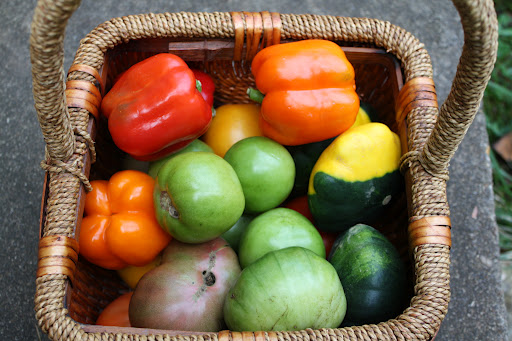
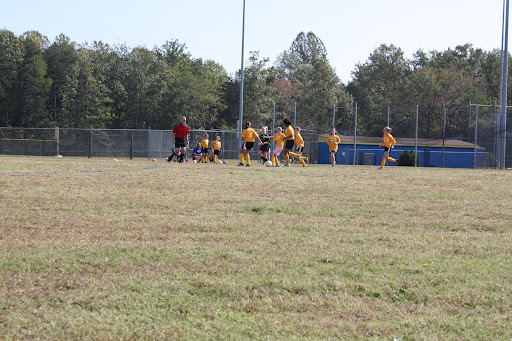
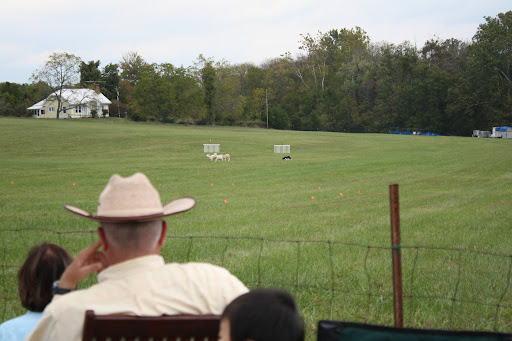



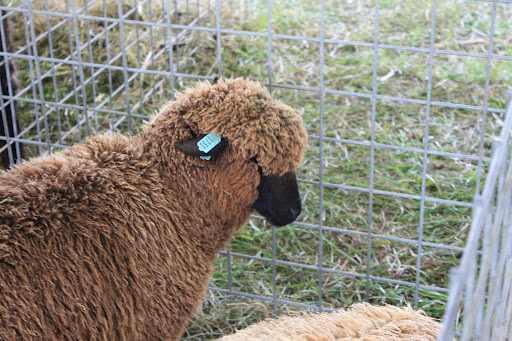
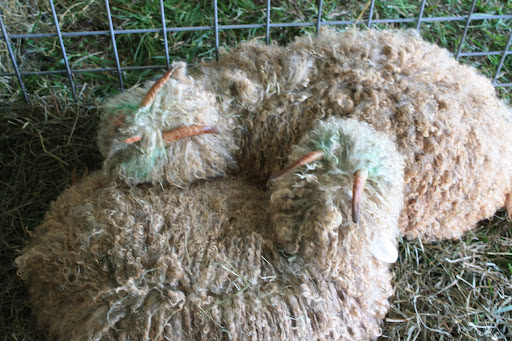
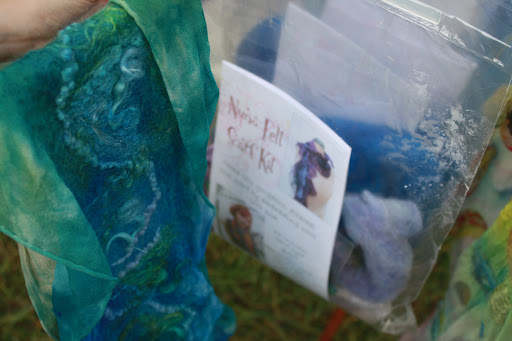
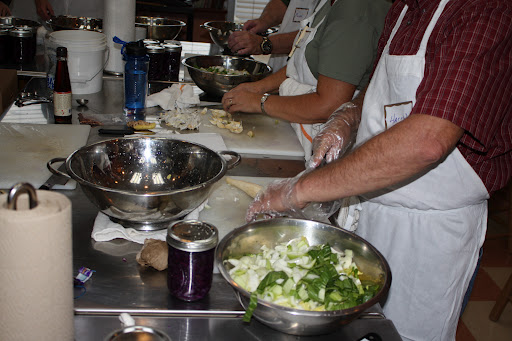
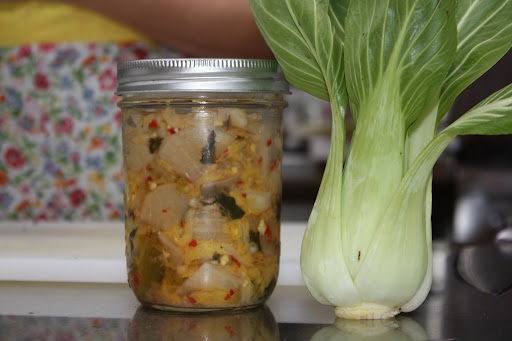
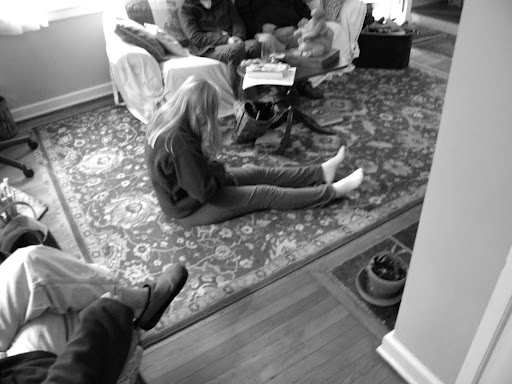
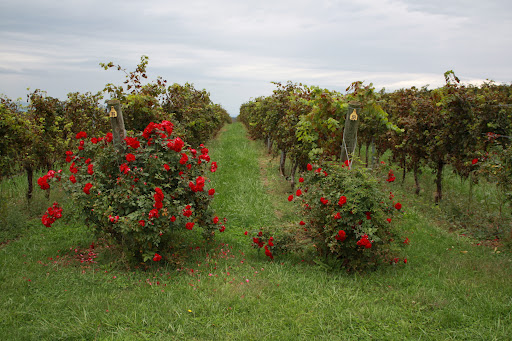
Hot air balloons overhead, market, soccer, the Fiber Festival and Sheepdog trials (where I left the camera with Edie, only to find yet more photos of her toes), an unwilling photo subject, inspiration for new projects, a fermenting class at the cooking school, visit with grandparents and a grown up field trip on a dreary Monday to one of the nearby wineries.
Not pictured – new orange yarn that’s already being knit up into a yummy scarf, a home run on a homemade pizza crust, a sublime batch of sourdough bread served with the last of the bacon jam & melon jam, and confirmation that the okra pickles need a few more weeks before they are prime for eating.
Warm Weather Whites (In the Kitchen Series)
This post was previously published for In The Kitchen Magazine, which sadly, is no longer. This article ran in July of 2011.
At the onset of warm weather every spring, I break out the all the accoutrement of the season – shorts, flip flops and fill my wine rack with a variety of white wines. As the season winds around, I find myself gravitating towards lighter and sometimes more effervescent wines.
Vino Verde, for example, is about the most delightful wine I can imagine on a hot summer day. A Portuguese wine, it is light and fruity, with a definite pétillance to it. It is high in acid, so it has a certain crispness that I liken to lemonade, and has a lower alcohol content, which makes it a perfect ‘by the pool’ wine. On those really cold winter days, when I need to pretend I’m somewhere warm and tropical, it’s Vino Verde I imagine myself drinking. It is always the first bottle of white I grab in March, when I begin stocking for the warm weather, because I want to make sure I have it on hand when the time comes. Best of all, Vino Verde is a fairly inexpensive wine – you can find great bottles of the stuff for under $10.
If you really want to impress your friends, seek out a bottle of Txakoli (sometimes known as chacolí) for an afternoon of fun. Txakoli is a Spanish wine, very similar to Vino Verde, with a crispness and touch of sparkle thanks to a high acid content, but has a bit more heft in the body from its Portuguese counterpart. It was a primarily home distilled wine for many years, but it was rediscovered in the 1980’s and is finally being imported in this county. It’s worth seeking out.
If sweet is more your preference, then a bottle of Moscato is something you must try if you haven’t already. A light, fruity, slightly sweet, frizzante wine from Italy, Moscato is considered a lovely aperitif, brunch or dessert wine. Talk about versatile! Moscato typically has hints of peach (among other fruits) and is low in alcohol.
Of course, if you are just in the mood for something sparkling, why not try a bottle of Prosecco? Prosecco is an Italian sparkling wine that is dry, with subtly sweet fruity notes. In recent years, it has become a popular and less expensive substitute for Champagne. It also mixes beautifully and is the main ingredient in the classic Italian cocktail, Bellini.
By this point, you may have noticed some similarities in these suggestions. All are lower in alcohol content, which is recommended for those blistering hot days, and are lighter bodied wines. They all come from countries with a Mediterranean climate – hot, dry summers and cool, wet winters. I can’t think of a better recommendation for a wine to drink on a hot summer day than one that hails from a climate well versed in hot summer weather.
Life in Wine Country.
One of my favorite things about living here in Charlottesville is the local wine industry. Virginia is one of the top wine producers in the country, far behind California, but it’s still roughly a $750 million industry. Not too shabby. The nearby Monticello Wine Trail accounts of over half the state’s total acres planted in vines and is the largest AVA in the state. There are 29 wineries listed on their website. I’ve read you can do the entire trail in a weekend, but I don’t see how that’s possible. You might be able to visit all of them, but no way can you possibly enjoy all of them squeezed into a few days.
Over the last week, I’ve had a number of invites to go visit some of these wineries with various girlfriends. I’m declaring it the new mommy playdate trend. We must all be getting nervous about the hiatus in the big yellow angel coming by in the morning, whisking the children away to a better place for the day. Clearly the best way to prep yourself for that is to head out to some of the local wineries for the afternoon. Visiting a number of them in such a short time period allows one to appreciate how different each winery along the trail is.
Kate invited me to come along on a visit to Glass House Winery one day last week. We grabbed some sandwiches on the way out at the Hunt Country Store and made a picnic out of it.
Glass House is by far the most eclectic winery I’ve visited. It’s contemporary architecture, with a large glass conservatory that I imagine would be a wonderful place to visit when the grey days of winter start getting to be a bit too much. Planted in front of the building are a number of tropical looking plants as well as some interesting metal sculptures, some of which are depicted on the labels of their wine.
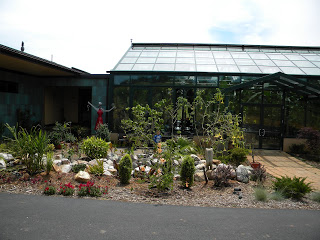
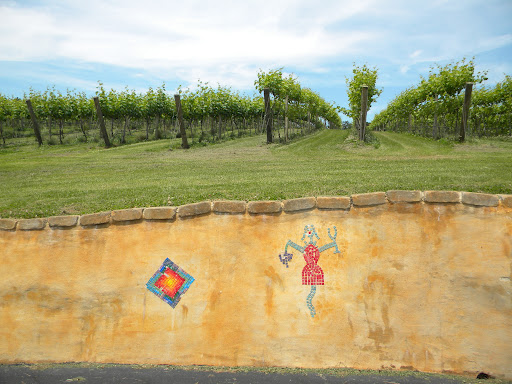
The retaining wall in the parking lot included glass tile mosaics. Everywhere you looked, there was a treat for the eye, whether it be the natural landscape or the uniqueness of the man made structures.
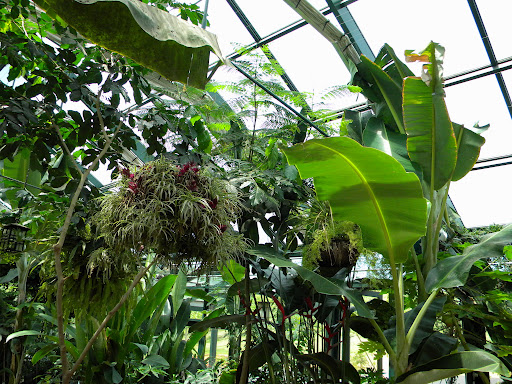
We didn’t spend time in the conservatory, I just stepped in for a few quick shots. It was way too nice of a day outside for me to be inside, even if it was a tropical paradise.

I think this was my favorite detail in the whole building. The entire hall to the restrooms and beyond was made to look like a large wine barrel. The winery hosts regular music events in the glass house. It has a funky, fun vibe that I haven’t seen in any other winery in the area. The tasting room is full of natural light that showcases the beautiful scenery surrounding the winery.

All their bottles use a glass cork, which is a closure I had not seen before. It’s an elegant alternative to screwcaps and plastic corks.

We tasted three white wines, a Pinot Gris, a Viognier, the Vito Signora (made from Traminette grapes), a rose, a red, “The Twenty First” (named in honor of the 21st amendment which repealed prohibition) and their signature dessert wine, the Meglio del Sesso. It’s made of Norton, Chambourcin, Cab Franc grapes and real chocolate. After the wine is filtered, the cocoa is then used to create the winery’s hand made line of chocolates. When you taste the dessert wine, you are given a bite of chocolate to go with it. I can only use one word in describing what that was like – YUM. I may need a few bottles of the Meglio del Sesso to go with my next chocolate cake.

As for the other wines, the red wine I tasted, “The Twenty First” is the one that stood out the most. It’s a blend of Cab Franc, Cab Sauv and Merlot that had a nice depth. It’s the type of wine that while highly drinkable now, could be aged for a few years and then I think it would be even more spectacular. The rose was made of cab franc grapes and was my choice to sip on while we sat on the patio overlooking the pond, with the vines and mountains in the background. It was a beautiful day in which I thoroughly enjoyed getting to know some new ladies. Thanks Kate, Jane & Val for having me along!

A few days later, my friend Kelly and I went out to celebrate her latest degree, a milestone on her path to her next two (another BS and an MS). Toasting her accomplishment with a glass of wine became a ‘let’s go visit some wineries’. We headed out to Barboursville Winery. It is one of the best known and most respected wineries in the area. They can boast they make the house wine for The Inn at Little Washington, that little 5 star restaurant you may have heard of that’s widely considered to be one of the best restaurants in the world. Barboursville has one countless awards over the years and for good reason.

It was the first Virginia winery since Thomas Jefferson’s failed attempts to plant Vitis Vinifera, a species of grapes native to the Mediterranean and other parts of Europe and Asia.
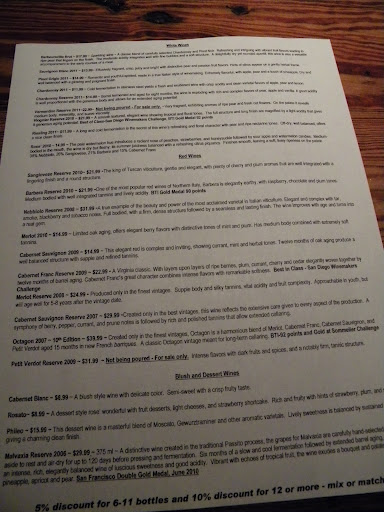
Of the twenty three varieties they offer for sale, we were offered tastes of twenty two of them, including ones listed that generally aren’t available for tasting. My perennial favorite Barboursville Wine is their Brut, a sparkling wine. Other standouts were their Sauvingnon Blanc, with crisp citrus notes that I’m a complete sucker for. Their Riesling is also delightful, more dry than sweet, just the way I like them.
As for their reds, I liked the Sangiovese, an Italian grape that is traditionally the backbone of Chianti. Although it was listed on the tasting sheet that the Petit Verdot Reserve was not being poured, we lucked out and managed to get a taste. I’m glad we did, as it was hands down, my favorite of their reds.
Other wines that stood out were the Cabernet Blanc, a blush wine that was a little sweeter than I like my roses, but light enough that it would be a bottle for a nice afternoon with friends. The Malvaxia Reserve stood out as well – it’s rich, luscious and while it’s listed as a dessert wine, I could easily see pairing it with a nice cheese plate.

No visit to Barboursville is complete without checking out the Ruins. I shot some pretty cool black and white photos of it as well.

Just down the road from Barboursville Vineyards is Horton Vineyards. With over forty wines in production, their tasting sheet was two pages.


At Horton, we were told up to twelve tastings are free, so we kept our tasting to that number. You don’t get a souvenir glass, but as I’m running out of room for them in my closet, I chose to just snap a quick shot of them. Take a picture it lasts longer is definitely true when it comes to me and wine glasses.

Although now that I look at them again, I may need to go back for some. They were commemorative for the 150th anniversary of the Civil War. Horton is in Orange County, not too far from some of the historic battlefields of the Civil War, the closest being Wilderness Battlefield.
Horton is the winery that first experimented with Viognier here in Virginia, a grape that has taken well to growing in Virginia, so well that it was named the official grape of the state in 2011. Of all the viogniers I tasted at all of the wineries, Horton’s hands down is the best. Not too sweet, not too dry, it’s a wonderful wine that pairs beautifully with food. Horton’s Late Harvest Viognier dessert wine is also worth mentioning. It’s rich without being overly sweet. Horton was also the first winery in Virginia to make Norton, a varietal that is a native Virginia grape. I am quite fond of Norton, it’s fruity without alot of tannin and Horton makes a good one. The Cab Franc, another grape that does well in Virginia as well as the Nebbiolo, a native Italian grape, were the other two red standouts.
Three different wineries, three very different experiences. While the tastings at both Glass House & Barboursville were the same price and came with a souvenir glass, I got far more wine for my money at Barboursville. The most personable, knowledgeable pourer was at Barboursville – he was far better skilled at juggling the different parties along the bar than any of the other pourers I came across. Glass House is a boutique winery while Barboursville and Horton are producers on a much larger scale. Horton appears to experiment far more than any other winery, with several fruit wines on their list. Curious as to how they would taste, I chose the Peach, which is blended with a small amount of viognier. It wasn’t overly sweet, but it didn’t taste like peaches either. I might try another one or two of their fruit wines in the future, just to see how they taste. The pourers at Horton didn’t offer much information as far as the wines or the winery were concerned. I realized how important the personality of the pourer is in experiencing a winery. Wine tasting should be fun. You can tell when a pourer has a pat speech they offer with each pour and you can tell when your pourer has a knowledge, not just of the wine they are pouring, but of the process involved in getting that wine to your glass.
My history of wine.
I have gotten some very positive feedback over the last year for my monthly wine column, Beneath the Cork, for In the Kitchen magazine. In last month’s issue, editor Rowena Morrell, announced she was giving up the monthly publication. It has been suggested I write more about wine here in this space, and so I shall.
I came late to drinking wine for I grew up a beer drinker. My grandfather would put me to work ‘helping’ him – which mostly meant fetching him beers from about the time I could walk. I was almost always offered a sip or I’d be allowed to share a beer, with my portion being poured into a small glass. To this day, I love splitting a beer. I have aunts and uncles who still split them with me too. One of them actually just started letting me have my own beer – I guess she thought I wasn’t old enough to drink a whole one. My maternal grandparents had frequent happy hours with their next door neighbors. It was my grandfather who taught us that what time happy hour was in London, and you could drink to that.
In college, I had a few boyfriends along the way that taught me how to drink tequila and bourbon, respectively. I’ll admit to a vodka phase and maybe there was a short lived girly drink phase, but once I learned to shoot tequila and then appreciate bourbon, that was it for me and liquor until a neighbor reintroduced me to gin & tonics a few years ago. Beer though, was my main drink of choice. Until Edie came along….
I gained a good bit of weight when I was pregnant with her and while most of it came off quickly, there was a lingering (more than a) few pounds that wouldn’t come off no matter what I did. I also found that beer filled me up quickly, so that if I had a few beers before dinner, I wouldn’t always want to eat dinner and this became more of a problem than it was when I was in college, since I was older and the morning after without dinner hurt after the age of 30 far more than they did when I was 20. I realized that switching over to liquor wasn’t a good answer either and it was suggested I learn to drink wine.
Over the years, I had a few friends try to educate me on wine, but I never really paid that much attention. However, I was not about to give up alcohol and I have a hard personal rule about my belly being smaller than my boobs, except for when pregnant. That meant finding a new drink. I started out by drinking a ‘flavor’ a friend had recommended back in college – an nice Australian Shiraz. I didn’t go too far out of my comfort range, sticking with Shiraz and Merlots. Some time not long after that, during Edie’s toddler years when I realized I just wasn’t happy with my day care options, but Pat insisted I find something to do to get me out of the house, I found a job at a new wine bar opening on the Downtown Mall – Charlottesville folks might remember VaVino, the wine bar that carried only Virginia wines. Not only did I find myself learning about wine, I was learning about Virginia wine. Over time, they began to carry wines from all over the world, which only served to expand my wine horizons, until it was sold to a local restaurant group. Eventually this group retooled the business to focus on Italian wines and food. This is where I learned about Italian wines, even taking a few classes on how to speak Italian. When Edie started school, I left the wine bar for a more traditional job, because by this point, it was hard to close a bar on Friday nights and then be up a few hours later on the soccer field.
There is a particular characteristic that runs through my family, where we mangle any language we can get our mouths around. It’s almost an art form. Consequently, there are many words I mispronounce. In addition to this (or maybe because of this), I somehow seem to be almost unable to pull off using anything past a five cent vocabulary word in conversation in any sort of credible fashion. Whenever I would attempt any sort of ‘wine speak’ my family and friends were pretty much in hysterics. Worse, my customers at the wine bar often let me know I wasn’t pulling it off either. Nothing like a complete stranger telling you how you sound like an idiot. So, I tend to describe wine and food quite simply. If I went anything past ‘dry’ or ‘fruity’, I would get strange looks from people. I vaguely pull off using oenophile when I write, but I have no idea how to begin pronouncing it to use it in conversation. When I took Italian lessons, my then 4 year old did a better job of grasping it than I did. And that kid has clearly most definitely inherited the family gene for language fail.
Despite this though, it was decided that perhaps I could be a fresh voice writing about wine – that I could make it more accessible, since I most decidedly do not pull off wine speak. I might not be able to speak about it in lofty terms, but I do know my wine. After people stop laughing at my inability to use language, they are always slightly amazed to learn how much I really do understand about wine. I love a big red, I love a nice dry white, I love a rose, I love fruity, and lately, I find myself strangely embracing Chardonnay after hating it for so many years. Really, I’ll try anything once and usually I can find something to like about it. I am on a constant search for the best bottle of wine under $10. Surprisingly enough, right now my favorite wine is a ‘grocery’ store brand, often on sale for around $5. I dismissed it for the longest time, simply because it was overly available and cheap. Often times, that is a red flag for a lesser quality wine. I gave into my curiosity one day though and was pleasantly surprised. This doesn’t always happen and I do sometimes regret those $5, but I have also regretted that $10 or that $15. If I’ve learned anything, it’s that wine doesn’t have to be expensive to be good.
End of the season.
It was bound to happen – the first frost of the year, putting an end to bounty from the garden. I still have some greens and herbs out there, but the days of fresh basil, peppers, tomatoes are over until next year. Sigh.

I ran around Friday and harvested. I filled a garbage bag with basil and Saturday, I made a few batches of pesto and froze it. I also froze a few bags of tomatillos, picked a bowl of tomatoes and a huge bowl of peppers. I think most of them will get pickled.

I picked every last flower that was blooming and threw them in a vase. I meant to go back and ‘arrange’ them, but then realized I really liked them just the way they were. And I loved how they looked on the coffee table next to my Aunt Anita ‘family’ sculpture.
It was also the end of birthday week. Edie had a slumber party, which meant we were kid free for a night AND the next morning. A dear friend suggested we go to dinner and so in the process of tossing about places to go, we found ourselves agreeing to at least begin with a margarita from Continental Divide. Surprisingly, it wasn’t too crowded and we thought about staying for dinner. But as we toasted my age and I joked that I was now “Two 21 year olds”, I looked around realized that I was easily twice the age of oh, more than half the folks in there. And suddenly realized that the C&O option sounded way better than Continental Divide. So, away we went. We were lucky enough to walk right in and get a cozy table in the bistro. A bottle of wine was ordered and I had the rare delight of not being involved in the selection! That right there was a gift.
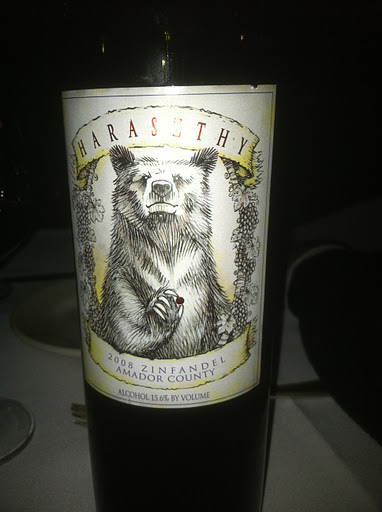
Having worked at a few variations of wine bars on the downtown mall, as well finding myself writing a monthly wine column, people seem to think I know wine. As a result, I am often consulted about what to drink. I loved being surprised by a bottle of Haraszthy Zinfandel, that had to be retrieved from the shed. Apparently that’s where they store wines that are not frequently ordered, which was quite exciting for the staff, as well as myself, I have to admit. It was a nice, big red to go with the cold evening. The fellows had the trout, which was about the most perfect fish I’ve had in I don’t know how long….and I had my usual C&O standby of rabbit, also wonderful, in a house made Boudin Blanc. I also had a glass of the Knight’s Gambit Petit Verdot. I mention them in my upcoming November wine column, so I couldn’t resist. For dessert I had the chocolate bread pudding, which is better than I make. And that’s saying something. They use brioche, making it incredibly light and dreamy. A Baileys and coffee was ordered for me and the two paired just wonderfully together. A fabulous cap for a fabulous evening.
Sunday morning, Pat & I headed out for the last birthday hurrah – brunch at The Villa. We hadn’t been there in ages and other than a name change (From the Italian Villa), it hasn’t changed much. It was parents weekend at UVa, so the place was filled with college students and their parents, as well as a few Zombies from the Zombie run that took place in the morning. It was a lovely finish to a good birthday week.
Next up, candy season. Happy Halloween!
Adventures of the local sort.
Sunday we went to the Fall Fiber Festival up at Montpelier. Every year, Edie likes to sit and watch the sheepdog trials (I think she’s waiting for Babe, the sheep pig to show up. Sort of like Linus and the Great Pumpkin.We even watched Babe Saturday night as a warm up). This year, a knitting friend told me she had signed her daughters up for a felting workshop, so I signed Edie & a friend up, and we had TWO child free hours left to wander. It was quite glorious.
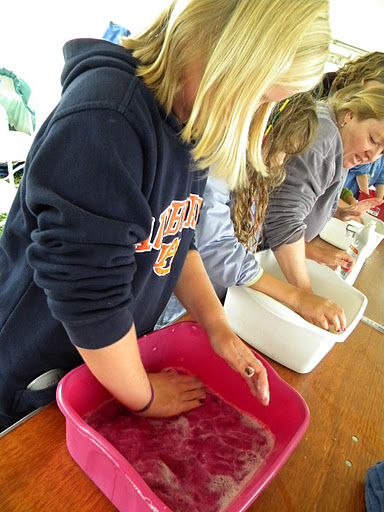
I swore I was not adding to my stash, and I did pretty good with that. I fell in love with some recycled silk yarn that was yummy orange, but as I already have a scarf I knit myself out of recycled silk yarn, I passed. I found some equally yummy orange bamboo yarn for a third of the price, so I grabbed a few balls of that instead. I really feel the need for a new orange scarf. I also got some ideas to use up the stash I have acquired – mostly through friends sharing theirs, as I do not need a yarn stash. I have quite the fabric stash and we simply do not have room for it all. Pictures of all that to come, as I came home and started some new projects last night.
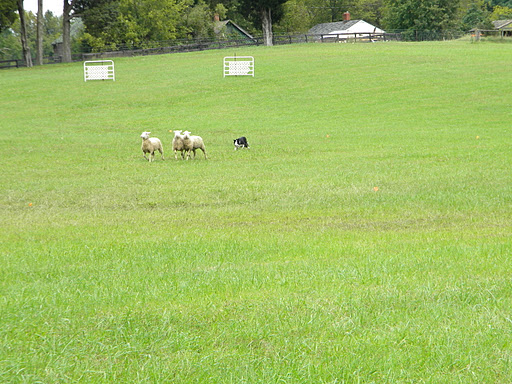
After they finished their workshop (I have not yet been allowed to photograph her finished product. Someone is practicing hard to be a teenager these days.), we had lunch and watched a wee bit of the sheepdog trials. It was cold, damp and windy, so we didn’t stay too long. Babe, the sheep pig, did not make an appearance. There’s always next year, right?

Today I headed out to Virginia Wineworks for a tour, in the name of research for my monthly column, Beneath the Cork for In the Kitchen Magazine. (The October issue is up – you should definitely go check it out!). Philip Stafford was kind enough to spend some time with me, showing me around. I got to see some of their brand spanking new packaging equipment and definitely got inspired for more than a few articles to come. Thank you Philip for taking time for me today. If you have the chance to go hang out at a winery during harvest, I highly recommend it. I don’t want to give too much away from the articles I plan on writing from today’s visit, but they are doing some really great stuff for the entire Virginia wine industry down there at Virginia Wineworks. It shouldn’t surprise anyone that I love to drink local as much as I love to eat local. Should I ever get inspired to plant my own grapes, I am definitely taking them to those guys to turn into some tasty wine.
 Chicken Wire & Paper Flowers