Valentine’s treats that are so easy you almost can’t stand it.

I love Valentine’s Day.  Not that I love the commercialization of  it – I hate the commercialization of everything.  But as I like to blog here every year, Valentine’s Day marks the start of this family and so therefore, it must be noted in some fashion.  Nothing big and splashy of course – just a wee something.  Keeping with my love of handmade gifts, I started making these treats for my valentines a few years ago.   They are quick, easy and yummy – my holy trinity.
The original recipe came from a post on Design*Sponge, but I’ve altered it over the years to be the one I’m about to share with you, so I’m not linking to the original.  If you can melt chocolate, you can make these.  They are that easy.
A few notes – I use good dark chocolate and natural peanut butter.  The original recipe calls for crushed graham crackers and salt to be added to the peanut butter mix, but I find it’s not necessary.  I make them in mini-muffin tins, as I find a full size muffin tin peanut butter cup to be a little too much.
Chocolate Peanut Butter Cups
2 bars (4 oz each) good chocolate 
3/4 cup peanut butter
3/8 cup powdered sugar, sifted
Melt a bar of chocolate in a double boiler (or use the microwave method of melting chocolate which means putting your chocolate in a bowl, letting it go for 30 seconds, stir and if needed, pop back in for another 15-30 seconds.)
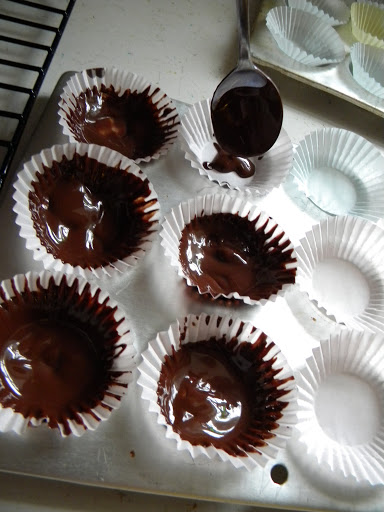
Using a spoon, spread melted chocolate on the bottom and sides of paper muffin liners.  Coat them generously – this is the bottom and sides of your candies.  
Chill in fridge for 10-20 minutes or until hardened.
Combine peanut butter with sugar.  Melt remaining chocolate.
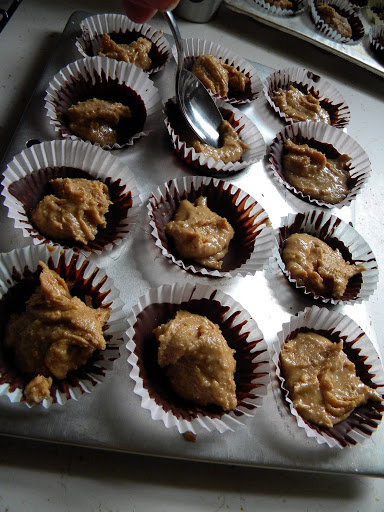
Place peanut butter in each muffin cup.  I like to spread it out a bit with the back of a spoon.  Dollop melted chocolate on top of the peanut butter, using a spoon to smooth out the tops.  Refrigerate for about a half hour or until fully hardened.
Sometimes I get jiggy with it and sprinkle sea salt on top.  Today I used bamboo salt. Because it was the first jar I grabbed when I opened the spice cabinet, that’s why. 

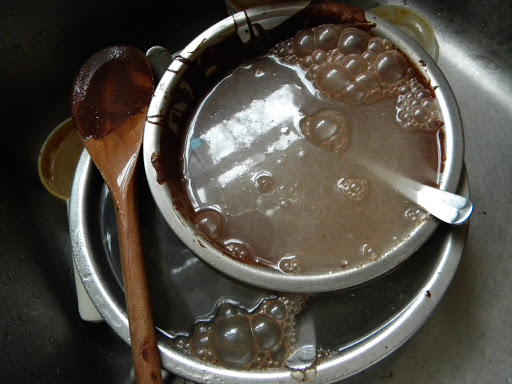
This is what is left to clean up.  If you can melt chocolate, you can make these.  And your valentines will thank you for them.
Yield:  24 mini muffin size peanut butter cups

Today’s Experiment.

I’d been kicking around the idea of putting together some cooking classes that weren’t just canning & pickling focused.  For starters, it’s a very seasonable topic, sort of a one and done class done at various venues around town, but also because I do more than just preserve food.  I preserve food because I like to cook it, because I’m passionate about knowing exactly where our food comes from and I want to ensure that my family eats local all year long.  Really, canning & pickling is just the first step, one small part of my cooking puzzle.

So there I was, kicking this idea around, trying to find a focus (why oh why does everything seem to require a freaking focus already?!?!?!) when I got an email from a friend, asking if I was interested in leading a cooking class for his department as their staff retreat.  Would I? I love when the universe sends me signs like this, I really do.  Dave’s a regular reader, so he had a few ideas of what he wanted me to teach them, but after a few suggestions, he left it up to me.

The hardest part was finding a space in which to do this.  Budget was key, which ruled out a number of places.  If only my kitchen wasn’t so small and dark, perhaps I could teach more than one person at a time out of here.  One of his coworkers was able to get a church kitchen, which actually could not have worked out better.  It was fairly well appointed and was made for a small group to cook together.

As this was an all-day class and Dave requested we do several dishes together, I had them start with lunch, which was pizza.  Once that prepwork was done, including making the dough, from scratch, by hand, we moved on to the big attraction.  Gumbo.

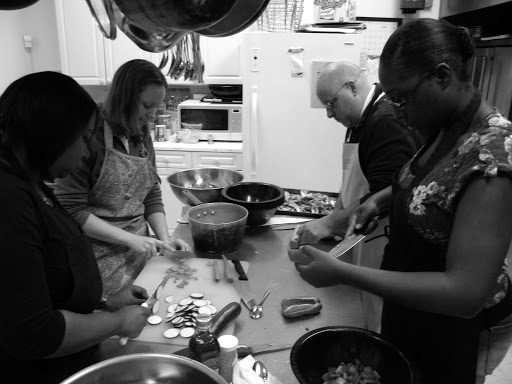
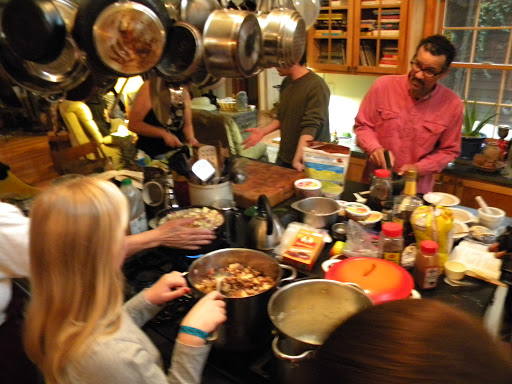
I’m really not sure there is anything as well suited to team work as gumbo is. There is plenty of chopping to go around, there is roux to be made as well as broth.  I walked them through how I like to do it – using as many burners as I can. At one point, we had the broth simmering, sauce for the pizza cooking, roux browning and the holy trinity sauteing to start the gumbo.

  If you take it step by step, you could spend all day making a pot of gumbo.  As much as I think it’s worth it, I also love doing as much as possible all at once.  Even that though, takes prepwork, and teamwork.
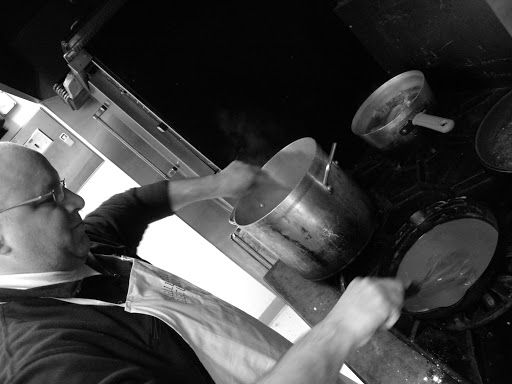
 Although Dave did try to do a big chunk of it on his own.

Lunch was absolutely delish if I say so myself.  We did a roasted butternut squash, sage and goat cheese pizza (which Dave had requested after reading that post) as well as a plain cheese pizza.  Just yesterday I read a piece on Beyond the Flavor about Michael McCarthy of Dr. Ho’s Humble Pie making pizza at home and couldn’t help but notice his oven was much hotter than I set mine – 550 vs. 450. Inspired, I decided to experiment with that temperature and honestly, I have to say that that cheese pizza tasted just like one you’d get a pizza shop.  I’m still patting myself on the back for using that bit of knowledge – so much so that I came home and have already started the dough for dinner.

Thankfully, no one else in this house had pizza for lunch, so there will be no lectures on their part about how pizza twice a day might not be healthy, not to mention boring.  At least she got over the whole no cold pizza for breakfast thing.

I digress.  After we feasted on our pizza lunch, we headed back into the kitchen.  There, I showed them how to make the easiest and most divine chocolate cake ever.  I love sharing that secret – that a handful of ingredients, assembled in 5 minutes and baked for 30, can fool everyone you know into thinking you are a baking genius.

One of the downsides of cooking around your camera, is that sometimes you get stuff on the lens. It does, however, lend a dreamy quality to the picture, doesn’t it?

We finished the day with biscuits. I got to expound on a bit about my biscuit theory and shared with them my whole grain version, even throwing a little bit of lard into the equation.  After putting a few of our biscuits in the oven to be sampled, the rest were divided and packed up, to be baked later in the day at home.  After all, who wants to spend a day cooking only to have to go home and do it all over again?  Not only did everyone take home biscuits, they had been instructed to bring along tupperware and so everyone took home gumbo after sampling the finished product.  It was declared a success and while I am still mentally critiquing myself as to what I can do better, I also changed some things on the fly that turned out pretty good.  That’s the secret to good cooking (and life really), is being able to adapt without flinching.  It’s all in the instincts.  Can you convey that in a cooking class?  I sort of think I did.

Making Mincemeat.

During some conversation with my friend Leni at some point either this past fall or summer, the topic of mincemeat came up.  Leni having recently retired this past year as the African-American Historian at Monticello,  I knew that our exercise in mincemeat was going to entail historically accurate recipes, at least one of which would probably be from Mary Randolph’s  The Virginia Housewife cookbook.  First published in 1824, it’s considered one of the first American Southern cookbooks and a fairly decent record of how food at Monticello was probably prepared. The conversation had sprung out of discussions of what she was going to do with the all the various parts of the pigs she was then raising.  I was slightly curious to get a pig’s foot or two to try (what else) pickling them while she was more interested in boiling them down and making mincemeat out of them.
 
Yesterday was mincemeat making day.  It seems the Mary Randolph version calls for venison, which Jackson supplied, as well as some bear, which was used to make an 1839 Kentucky Housewife by Lettice Bryan version of mincemeat.  
 
One of the things I like about heading out to gatherings at Leni’s is that you never know who you’re going to meet there.  A few years ago, I’d heard of Jackson’s classes in which students learned to hunt, dress and cook their catch.  I loved the idea of it, would love to actually take it one day, only it seems (to me) that hunting requires patience (that whole sit in the woods thing – I cannot possibly sit still that long) one of those things I’m convinced is an over-rated virtue, mainly because I lack it.  Ideally, I’d rather skip to the butchering and cooking part, getting someone else to do the hunting for me.  
The meat Jackson brought technically was roadkill – the car in front of him hit the deer and I missed part of the story on the bear, catching only the tail end of the tale where he actually completed the killing of the bear. So it wasn’t like either animal was sitting by the side of the road for who knows how long.  I share this because I really just like bragging that I’ve eaten roadkill.  (Although as I typed that, I realized it’s not the first time I’ve had roadkill.  Hey, it’s free, grass fed, organic meat.)
In addition to Jackson, there was his girlfriend Helenah, Jenny, Jessica, two of Leni’s sons, her granddaughters, my Edie and lots of cameras.  We jumped in, with the venison version of mincemeat on one burner, the bear version on another, Leni’s pork version on a third, with a fourth burner being devoted to creating the filling of pelmeni – a Siberian dumpling made with bear.
As I was heading out yesterday, Pat asked if I even liked mincemeat, reminding me that it had been served at various family gatherings over the years to much avoidance on my part.  To be honest, I wasn’t quite sure I would like it.  I find that cooking meat well is an art, one that many members of my family lack, so I tend to avoid anything they made with meat it in over the years as a self-preservation technique.  Trust me, if you had grown up eating some of the meat I was served on a regular basis, you’d avoid it too.  I’m always willing to try something though, especially if it’s prepared by someone I know is a good cook.  Considering Leni has not only raised, but prepared some of the best pork I’ve ever had, I knew I was in good hands here.
There was much similarity in the recipes Leni had us using.  I was surprised (and delighted) to find that each one called for large amounts of fruit, generally in equal amounts or more to the meat and suet, of fruit in the form of apples, raisins and currants.  Brandy, cider, sugar and spices were also added, then the mixtures bubbled on the stove top for a few hours.
While they cooked, we feasted on some tasty smoked pork that Leni had prepared and then I learned how to make the pelmeni, which essentially is a pirogi.  I’ve always wanted to try making them but have been slightly intimidated.  Thanks to Jenny telling me I could just get going on the next batch and not wanting to appear like I had no idea what I was doing,  I just did what I was told, grabbing a dough ball, rolling it out and jumping into the process.  It certainly helped that the dough was positively dreamy to roll out, which immediately took a huge chunk of intimidation away.  (You know I walked out of there with that recipe too.  Because that is what I do when I stumble upon something like that.)
The pelmeni filling was finely chopped onions, cabbage and bear meat, which was cooked before being rolled and then boiled in broth for a few minutes before being served with fresh dill and sour cream.  
Leni thought that mince tarts would be a better way to serve the mincemeat rather than one large pie.  To differentiate between the venison and the bear mince tarts, the venison tarts had a dot of dough on top. As it was a savory filling, she used lard in the crust, making them incredibly flaky and savory themselves.  A perfect pairing.  
Verdict?  I liked the mincemeat.  There was so much fruit in the mix that the meat added texture more than anything else.  There was a nice savoriness about the tarts. The venison version, which was based on the Mary Randolph recipe was a touch more savory than the bear.  I had prepared the bear version, following the Kentucky Housewife recipe, substituting allspice for cloves that were MIA as I was putting it together.  By the time the cloves had appeared, I hesitated on adding them to the allspice, so I skipped it.   As the pork version needed more time, we did not sample it, although Leni assured us all she’d get a jar to us in the near future.  I came home with a pack of pelmini for the freezer, as well as two pint jars of bear mincemeat filling that I look forward to making into tarts over the next few weeks.
Yesterday was a learning experience on several levels – I love cooking with other great cooks because I never fail to learn something new from them. There was history, specifically food history – did you know that historically most wild game was referred to as venison?  I did not.  There was the typical small town connections made that make me love Charlottesville, where it seems everyone sort of knows everyone else somehow, even if you’ve never actually met before.  I listened in on and had some inspirational and informative conversations.  As I’m still getting over this nasty upper respiratory bug, I was not entirely my enthusiastic self, but it was a fantastic memorable day nonetheless, one that I shall be mulling over for some time.  Thank you Leni for hosting, introducing me to mincemeat as well as everything and everyone else I got to know yesterday. What a treat of a day.

The Oatmeal Post.

It seems every blogger in Charlottesville has at least one blog post on the subject of oatmeal.  This one is mine.

Oatmeal has been my go-to winter breakfast as long as I can remember.  It’s evolved from those instant packets that you just add hot water to, to cooking it on the stove in a pot to my current daily microwave version. 

I know, there are so many great ways I should try oatmeal.  I’m sure everyone has one they want me to try and while I’m quite sure they are lovely, my daily oatmeal is yet another one of those habits I have had my entire life and I do not feel the urge to mix up something that still works quite well for me.  That whole idea behind not fixing what’s not broken.  After all, I am the gal who’s worn the same thing since college – black tshirt, demin, boots (or clogs).  I am a creature of certain habits.

I like my oatmeal with raisins, cinnamon and brown sugar.  I eyeball the amounts every morning, a sprinkle of this, a pinch of that, and it tastes the same every day.  Well, except for the day I confused the jar of ground cayenne with the ground cinnamon.

I like quick oats – they cook faster.  Plop them in a bowl with the toppings, add water, and microwave for 2 minutes.  Stir and eat.  I actually have tried variances on this, but I always go back to what’s quick and what works. After all, I was a devoted instant oatmeal gal for the first 20 years of my life.  I want fast and easy in the morning.  I am capable of making other forms of oatmeal – the wee one in our house finds my go-to version boring, so on her behalf, I have mixed it up, getting so jiggy with it, I’ve used fruit butters in the mix.

I found myself without raisins the other morning. Vaguely remembering my mother, not being able to find my preferred raisin cinnamon spice packets once upon a time, handing me an packet that featured dried apples with my preferred spices, telling me to try it, that I should branch out. It was a good substitute, but I prefer to eat my apple every afternoon as a snack, not in my morning oatmeal.  However, there I stood the other morning, with no raisins on hand.  Desperate times.  I reached into the fridge and grabbed an apple.  I chopped it up and threw it in the bowl in lieu of raisins.  I cooked it.  I ate it.  It was a good substitute.  I branched out.  I actually ate it that way two mornings in a row this week. And now that I have raisins on hand again, I might try combining the two.  Talk about getting jiggy with it….

Why good cooking is dangerous.

My go-to dish when we eat at any Mexican restaurant is Chili Rellenos.   I had them somewhere once upon a time stuffed with a blend of cheese and potatoes, which made my little Irish potato loving self think that was quite possibly the best version ever.  I’ve tried my hand at making them myself a few times over the years with poblanos I grew myself, with mixed success.  They are a little bit of work and while I do many things from scratch, I bake my own bread, I can, I pickle and all that jazz, I really not-so-secretly prefer one pot, one paragraph dinner recipes.  Chili Rellenos is not one of them.  You have to roast the peppers, you have to peel the peppers, if you are stuffing them with anything but cheese you have to precook that. There is the sauce to go on top and something to round out the entire meal.  Really, much easier to just go out and order it from your favorite Mexican restaurant.  

Because I spend so much time putting up produce from about May through now, I just happened to have some pre-roasted and peeled peppers in my freezer, ready to go.  I pulled them out the other night and while they were thawing, I threw some sweet potatoes in the oven and baked them.

When I was at city market a few weeks ago, there was a farmer selling sweet potatoes by the bucket.  Of course I had to get some and now have a glut of them.  I also had some goat cheese hanging out in the fridge and the idea of a goat cheese sweet potato version of chili rellenos struck me as a really great idea and one I could just taste.

I served them up on a bed of grits and man, they were good. They were even better than I thought they would be.  As I cooked up the sauce to go with them, I realized it was basically the same sauce as the one I make for enchiladas.  There was a bit of a kick from the chilis I used in the sauce, as well as from the fact that I did not remove all the seeds from the peppers I stuffed.  It was fine for me & Pat and Edie was a trooper about it, so it turned out okay.  I think I have a few more whole roasted peppers in the freezer which are definitely going to be made in this version of chili rellenos.  I don’t think any Mexican joint is going to come close to touching how good these were.  I hate when I spoil it for myself, especially something like this.  The down side of cooking, definitely.  Sometimes you really should stick to take out.  Yes, I said that.
 

My experiments in bread baking have achieved a new level of goodness as well.  The last few batches I’ve made of both extra tangy sourdough bread as well as sourdough baguettes have been scrumptious. I’ve used whole grain flours in them and have given them extra time to rise.  A few years ago, I assisted in a bread baking class at the cooking school taught by Gerry over at Albemarle Baking Company, who makes the best baguettes this side of the Atlantic, hands down.  Among the tips he shared for baking good bread was letting the dough have plenty of time to rise and let the yeast do it’s thing.  Admittedly, it had not clicked with me to try this with bread recipes other than his, but in making recent batches of bread dough, I’ve realized that these have sat longer than called for, to spectacular results. Turns out that guy might know actually know something about baking after all.  I’ve also been experimenting with adding extra gluten as well as water when using whole grain flours.  The last baguette batch I think I used whole wheat pastry flour combined with regular whole wheat flour as well as bread flour.  I had a jar of unlabeled mystery flour, it could have been whole wheat pastry flour, it could have been high gluten flour I keep on hand for pizza dough or it could have been some rye flour.  Not really sure. It was also way too sticky for me to knead it long enough and somehow,  despite all that, that bread was light and airy and delish. Another eureka moment I recently had was to make the entire recipe, even when it results in 2 loaves or 6 loaves, and before the second rise, pop the extra dough into the freezer.  That way, the next time I’m feeling like a loaf of fresh baked bread, I don’t need to start first thing in the morning.   This has been met with much applause by the waistband of my jeans, because as you can tell by the photo above, I cannot stop eating the glorious fruits of my labor long enough to take a picture of a full loaf of bread, which is dangerous when you just pulled 6 loaves out of the oven.

By the way, that was a foot long baguette when it first landed on that cutting board.

Brunch (not entirely) fail.

You might not realize this, but in addition to pickling everything in sight, I’m also a big fan of turning things in fritters – you know, shred it, add flour, baking powder, seasonings, egg & milk and fry it up in a nice little patty presentation.
Latkes are essentially fritters. Squash are excellent fritters and we eat corn fritters weekly during the summer, when I buy corn on the cob by the gallon. You can make a meal of corn fritters, adding some cheese and bacon bits to them….
I’ve been experimenting with spaghetti squash lately. I like it, but serving it in lieu of pasta with some sauce, especially a red one which is supposed to be healthier than say, a cream sauce, gets kinda old kinda quick to me. (That may be my next experiment with it now that I think of it – a spaghetti squash alfredo dish, because I like to mix my healthy with my not so healthy, everything in moderation you know, including moderation.)  I made a wonderful little casserole with spaghetti squash a few weeks ago, combining it with ricotta and spinach that went over well.  I had a squash in the fridge I needed to use up, so I threw it in the oven Saturday evening.  As it cooked, I thought how it might be very well suited for fritters – after all, it’s naturally shredded.  I mean, hello, it’s just asking to be frittered, yes?
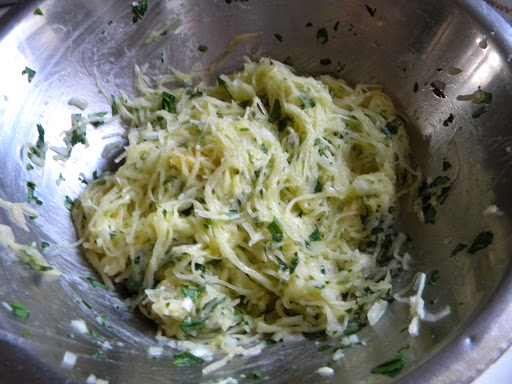
For various reasons, the spaghetti squash fritters got bumped to brunch Sunday morning.  I added about half a finely diced onion, a few minced garlic cloves, finely chopped parsley, salt, pepper, baking powder, flour, beaten eggs and milk. 
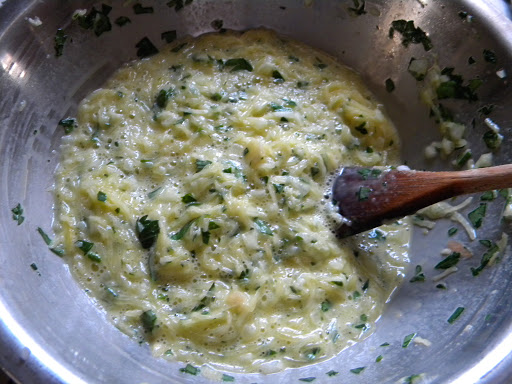
I wish I had photos of lovely golden brown fritters to show you, but for the most part, they turned out looking exactly like that batter there.  No matter how much flour I added to absorb the liquid, the batter remained exactly that liquidy until cooked. Honestly, all that liquid did in the frying pan was turn solid.  They were edible – I think the spices is what made that so – but they didn’t look pretty.  I may have added one too many eggs.  I may have added too much milk.  I may have not fried them in enough oil. It may have been A, B, C or D: All of the above.   At any rate, my grand inspiration to share a delightful new way to enjoy spaghetti squash was most certainly not realized. Sigh.
That’s the thing with experimenting in the kitchen – even the best cooks have failures. Sometimes that’s just the way the cookie crumbles.  Or the fritter fries….

Just to say.

My friend Kristin lost her son not quite three years ago and started a foundation in his honor.  Our hometown paper did a beautiful story on her that you can read here. 

And then go the website for the Jedediah Thomas Smith Foundation and pre-order the forthcoming foundation cookbook.  It will make fantastic holiday gifts for the cooks in your life, it helps a good cause  AND includes a recipe from me – my Aunt Loretta’s Mrs. Van Popple Cheesecake.  All proceeds go to the foundation, which gives assistance to families battling childhood cancer.

I still carry a picture of Jed in my wallet.  It reminds me that each day is a gift, to not take anything for granted.  And to remember a very special little boy who’s short life has left a long lasting legacy.

Biscuit theory.

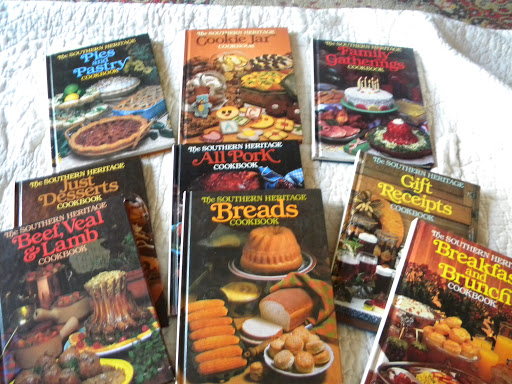
I have long held the theory that if I just found the right biscuit recipe, I would be able to make flaky, delectable biscuits that my family would rave about.  Over the years, I have sworn by this recipe and then that one.  Among my cookbook collection, I have dozens upon dozens of biscuit recipes – my Southern Living Southern Heritage series alone has 95 recipes scattered throughout its eighteen volumes.  The “Bread” volume alone has an entire chapter on biscuits, with subsections on beaten biscuits (5 recipes, including Maryland and Kentucky style beaten biscuits), yeast biscuits, basic biscuits (17 recipes, including 3 with ‘buttermilk’ in the name), as well as biscuits suitable to be served with tea. Both the beaten biscuit as well as the basic biscuit section feature picture tutorials with step by step how-to instructions.
It’s not entirely about the recipe though, it’s about the ingredients and technique of putting those ingredients together.  While many of the recipes I have call for all-purpose flour, one could assume all flour is the same, when in fact, all purpose flour differs from  region to region.  Southern all purpose flour is made with soft red winter wheat, which has a lower protein and gluten content than what is available in other regions of the country.
I first learned this in conversations with my friend Mark down at city market this summer.  He often sets up a stand, handing out samples and recipes of dishes made with local produce.  We share similar interests in food and when he’s down there, I find myself engaged in conversations with him and other foodie types, discussing things like pickles and grits and curing your own meats and yes, flours.  Turns out that while I was reading Game of Thrones on my summer vacation, Mark was reading about biscuits.  Three books worth in fact.
As a baker, I knew the importance of different flours – high gluten flour for pizza crusts that resemble the ones your favorite local pizza place makes,  Cake flour for lightly textured cakes, pastry flour, whole wheat flour, rye flour, buckwheat flour and more, including just plain old bleached & unbleached all purpose flour, but even I did not know that flour was different from region to region, brand name to brand name.
Interestingly enough, my older (1946 & 1964) copies of The Joy of Cooking both call for cake flour in their biscuit recipes, saying that it will make for a lighter biscuit.  Nowhere else have I seen a peep about how the flour you use is a large factor in making your biscuits light and fluffy.
There are differing opinions on how much to handle the dough, whether to knead or not, some say to roll it out, others say to keep the rolling pin far away from the biscuits.  Beaten biscuits, which apparently are unbelievably light and fluffy are made by literally beating the biscuits for a good 20 minutes or until the dough starts to ‘blister’ and pop.
With it being soup season, that means it’s biscuit season too.  I made my first batch of biscuits the other night,  using a technique I picked up from Rachel’s pie class I assisted with this past summer.  She cuts her fat in in stages, handling the final crust as little as possible. This, combined with using a southern flour (which took visiting a few grocery stores, believe it or not, despite the fact that I live in Virginia, which is considered the home of the ham biscuit), resulted in what I think is hands down my best biscuit ever.
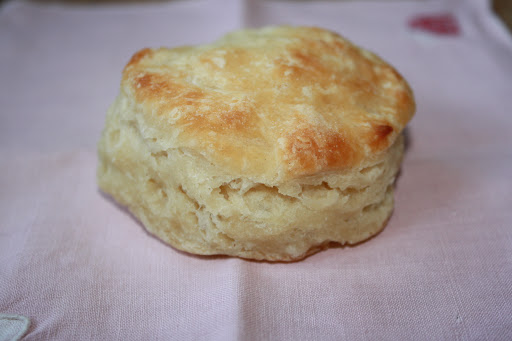
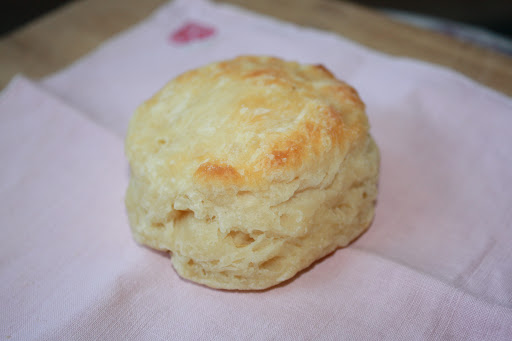
They were everything you want a biscuit to be – light and flaky, excellent with butter and some blackberry jam for breakfast the next morning too. I think I have finally figured out the secret to a good biscuit – it’s not necessarily the recipe, it’s the flour you use and how you put them together.  Really, so much to cooking is about the ingredients you use as well as techniques.
Here’s my next goal – to figure out how to make a biscuit using whole wheat flour that is just as flaky and light as a biscuit that’s made of nothing but white flour.  I know that whole grains are healthier for us and since a big part of my motivation in my food sourcing and cooking is so that my family eats healthy, nutritious food, I’m not comfortable with us eating home baked goods on a regular basis that only use white flour, especially the lighter versions with less nutrients.  I have a few ideas about how I want to go about developing my own flour mixes, namely I’m going to try mixing some cake flour with some whole wheat flours and seeing what those results are.  I’ve also gotten my hands on some lard, not from the grocery store, but from animals that have been raised humanely, not commercially.  I’ve read good things about cooking with lard and I want to see for myself how they work in my biscuits and pie crusts.

You are what you eat.  Which is why I spend so much time thinking about biscuits, clearly.

And finishing with Vegetable Soup.

In last week’s split pea soup post, I misquoted Cynthia and promised her I’d correct it.  She was talking about vegetable soup and not split pea soup with the addition of dill and sour cream (although it does sound good for split pea soup too and I’m totally trying that my next batch).  Clearly I got confused in the 50+ comments that post generated over on facebook.  Today is one of those grey, rainy fall days that practically begs for a pot of vegetable soup simmering on the stove all day, so I thought we’d talk vegetable soup, shall we?

My vegetable soup, just plain veggies, is never the same twice.  I usually refer to my vegetable soup as ‘clean out the fridge’ soup, sometimes ‘clean out the freezer’ soup.  It starts the same way, by sauteing onions ( and/or carrots, peppers, celery, garlic) in the oil (or half cup of broth) of your choice, then adding liquid such as broth, tomatoes as well as a variety of vegetables.  Potatoes are good.  Sweet potatoes can be a fun addition too.  Beans of any sort, corn, squash, greens (kale, swiss chard, arugula, cabbage), just about any vegetable you have on hand, even leftover ones, can be thrown in the pot.  Some days it’s leftover rice, others it’s barley.  Or I’ll add uncooked rice and/or barley early in the simmering process and let it cook.  Pasta is always a nice addition, but I like to cook it on the side and add it to the serving bowl to avoid it soaking up all the moisture in the soup and becoming soggy.

Let’s talk broth for a minute, shall we?  You can use just plain water when you make a soup, as long as you add plenty of good spices and/or combine it with tomatoes.  Using broth will deepen the flavor.  I know there are some that swear by homemade broth, but not everyone has time nor freezer space for it.  I keep dried broth powder from the natural foods store in my spice cabinet as well as a paste product in the fridge that has a much richer flavor than any bullion that I will throw in for extra richness.  I’ve also found that whipping up a quick vegetable or seafood broth is quite easy, it just takes a little bit extra time.  As I prep my veggies, particularly my onions, garlic, carrots, etc, I will throw the peels and ends into a pot of salted water with a bay leaf.  Simmer it for about a half hour or more, strain and there you have it, quick & easy vegetable broth.

Now for the seasoning.  Some days I’ll throw in some pesto from the freezer, other days chili powder or even curry.  Cynthia had a batch that she had added dill to and garnished it with sour cream.   We’re big fans of grated cheese on top of our soup here as well.  You can use soy sauce, tamari or even miso. I spent years trying to figure out how to melt miso paste into soup without bringing it to a boil and killing off the all good bacteria in miso, when it dawned on me one day to borrow the trick cooks use in incorporating corn starch into sauces – adding broth from the soup to the miso in a small bowl or cup, stirring until combined, and then stirring it into the pot.  Success every time.

Bread, of any sort, seems to be the classic soup accompaniment, because let’s face it, nothing takes the chill off a day like today better than a nice pot of soup simmering on the stove while a loaf of bread bakes in the oven.  Or a batch of biscuits.  Or corn muffins.  Or a baguette you picked up at the store that you warm up in the oven. But really, that’s an entirely different post.

Starting with Split Pea Soup.

Yesterday I posted on Facebook that I was making my first batch of split pea soup for the year.  Split pea soup is Edie’s hands down favorite soup, one she requests frequently and since she’s been under the weather with some sort of bug, she got her request.

I was first introduced to split pea soup by my friend Beppy in college – back in the days when I lived in a party house with two male roommates and I myself did zero cooking and even less cleaning, I remember coming home one afternoon to find Bep elbow deep in a sinkful of dirty dishes, cleaning away, with a pot of split peas simmering on the stovetop.  Since then, I cannot eat them without thinking fondly of her. That kitchen had the best light, even if it was otherwise a crappy kitchen with no counter space and an electric stove that my cat liked to turn on by pressing the power buttons across the top, starting at least one small fire.  Those were the days….

The thread that followed my post was a mass sharing of recipes, not just for split pea soup, but for Chicken Corn Soup and White Bean & Kale soup as well.  It inspired me to put them down all down somewhere together.

First up, what started the whole thing, split pea soup.

Becky’s Split Pea Soup
Take a bag of split peas, rinse and cover with water in a pot. Simmer for about 45 minutes.
Saute sliced onion, celery, carrots, garlic in bacon fat (or butter or oil). Add to the split peas, as well as broth, salt,pepper, thyme and barley. Cook for about another half hour or so.

Ashley suggested simmering it with a ham hock. 
Mary Ann puts sliced potatoes, ham, carrots, onion, coarse ground pepper, garlic, sea salt and celery salt in her version.
Cynthia adds curry powder.
Carla adds smoked turkey legs and a jalapeño pepper in addition to usual onions, celery carrots, garlic, salt and pepper.
Cynthia also adds dill, sour cream or yogurt to make it creamier.                 

Vikki’s White Bean & Kale Soup Stem & chop one bunch of kale; bring a quart of salted water to boil and simmer the kale for 15 minutes or so, til it’s soft. Drain the kale, put it aside, & save the liquid; should be about two cups left. Warm 1/4 cup olive oil in your pot; mince 4-5 cloves of garlic, sauté them in the oil for a minute or two, then add a large pinch of crushed sage and give it a couple stirs. Throw the kale back in, mix it up with the oil & garlic, then add the kale water plus enough extra water to make about 3 cups of liquid, plus two cans of white beans (drained & rinsed). I like to add some chicken bouillon or scrapings from the freezer, but you don’t have to; another good option is a rind of Parmesan. let it all simmer for 5 or 10 minutes, then puree it smooth with an immersion blender, salt as needed, and thin with a little extra water if you wish. sprinkle it with Parmesan before serving. Bread is a must.      

Becky’s note:  I make a similar soup, but I don’t always puree mine.  I add sweet & spicy Italian sausage that I cook in a separate pan until it’s fairly well cooked, slice it and add it after I puree (If I puree).   

Holly’s Chicken Corn Soup
Put 5 boneless chicken breasts, a cup of water, salt and pepper and a chicken bouillion in a crock pot to cook over night.
The next morning, shred the chicken, add it back to the chicken broth and add: large can chicken broth, bag a frozen sweet corn, 2 cans of creamed corn, 4 chopped hard boiled eggs (do NOT use hard boiled eggs already made from the store-I made that ‘stinky’ mistake before), also add: 1 small chopped onion, 5-6 (cubed) white potatoes, finely chopped stalk of celery and a few tablespoons of celery salt, 1/4 cup of sugar, and pepper. I have it all in the crock pot and will cook on low all day. it is really good and simple to make. Serve with bread. Occasionally have added 1/4 cup or so of whole milk if you want it a tad creamier.

Last but not least, is this recipe for split pea soup that Bonnye sent me this morning.

Bonnye’s Split Pea Soup

1lb dried split peas
2 quarts chicken broth, water or mix
1 clove garlic, minced or pressed
1pkg Canadian bacon,diced dash cayenne
1 ½ cups onion,
diced ¼ tsp thyme
dash cayenne
¼ tsp marjoram 1 tsp salt ½ tsp pepper 1 cup celery, diced 1 cup carrots, diced

Place peas, chicken broth, Canadian bacon, onions and all seasonings into a pot. Bring to a boil. Reduce to simmer, cover and cook for 1 ½ to 2 hours. Add celery and carrots. Cook for another hour. Will thicken in storage so add water if you wish when you reheat.

So there you have it, at least 7 different ways of making Split Pea Soup, two ways of making White Bean & Kale Soup and Chicken Corn Soup, a Pennsylvania Dutch classic I grew up eating at the school cafeteria – back when they still cooked school lunches.  All thanks to Facebook.  Happy Soup Season everyone!